The Contact Center Has a New Operating System
Most organizations didn’t set out to build a fragmented contact center. They built it incrementally: a routing engine here, a workforce management tool there, a chatbot bolted on. The result is a stack of point solutions that botch customer handoffs, lose context at every seam, and leave leaders flying blind on whether any of it actually works.
That is the problem Cisco is solving. And at Cisco Live 2026, the company made its clearest statement yet about how it intends to solve it.
Three Announcements. One Architecture.
Three launches anchored the customer experience story at this year’s event. Together, they form the architecture of what Cisco calls an agentic contact center: one where AI agents and human agents share a single operational plane, governed by a common context engine and secured from the inside out.
AI Concierge: First Impressions, Finally Fixed
The first announcement was AI Concierge, a pre-configured AI agent designed to act as the entry point for the enterprise customer relationship. It is not a basic IVR replacement. AI Concierge evaluates customer context in real time, including intent, sentiment, interaction history, and a persistent AI memory of how similar interactions have been resolved. From that foundation, it coordinates behind the scenes: pulling from the knowledge base, connecting to other AI agents, and tapping enterprise systems simultaneously.
When escalation is necessary, AI Concierge draws on quality management data to identify the best-placed human agent and completes a warm transfer, routing to the channel most likely to produce a positive outcome. It can even extend routing beyond the conventional contact center, reaching subject matter experts across the broader Webex platform.
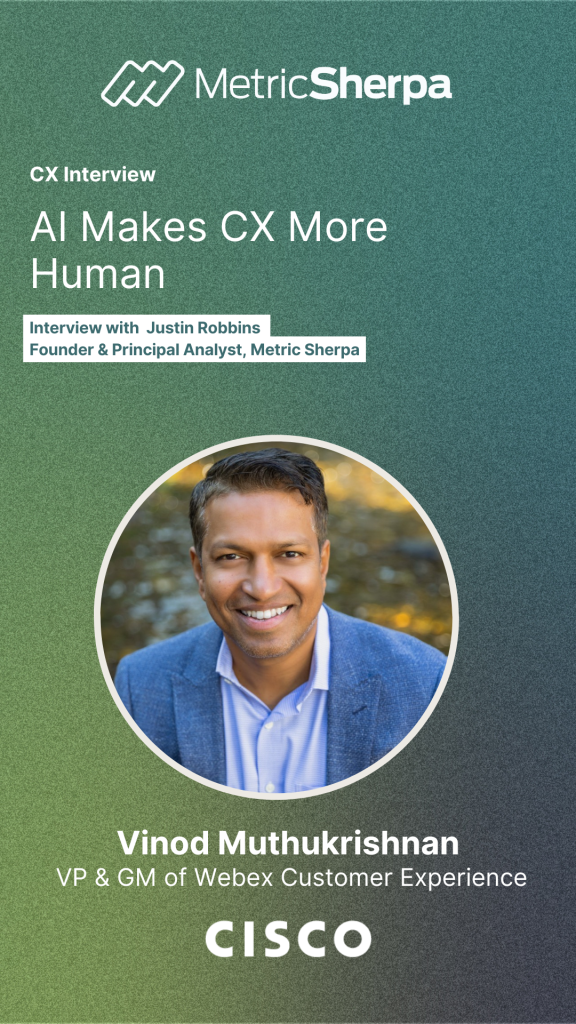
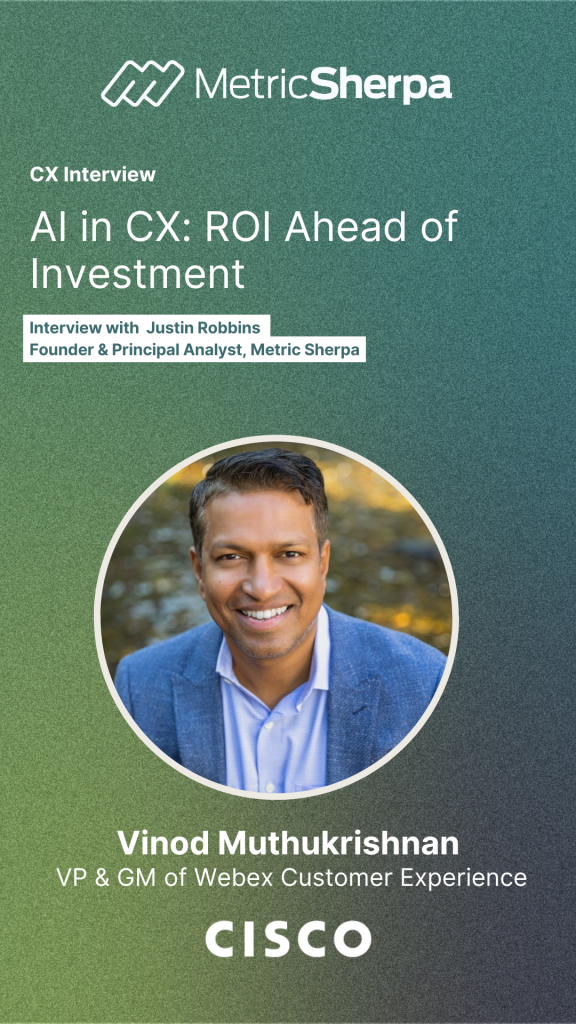
Vinod Muthukrishnan, VP and GM of Webex Customer Experience at Cisco, put the importance plainly:
“First impressions matter. The concierge AI agent that we announced today is incredibly important because you want to give human-like conversational experiences to customers, and yet it takes a lot. It’s not just sound quality and interoperability, it’s also what it can do.”
Businesses can configure their concierge through AI Agent Studio, plugging into brand content, workflows, and tone guidelines. The solution is targeted for general availability in Q4 CY26.
The Engine That Remembers Everything
The engine beneath AI Concierge and the broader Webex CX framework is what Cisco calls the Agentic Context Engine. It stores and applies persistent intelligence across every agent, channel, and customer interaction. Inputs include AI agent conversations, human agent interactions, operational metrics, third-party data, resolution history, sentiment history, behavioral patterns, and friction signals. The outputs are hyper-personalization, intelligent routing, effort reduction, and continuous system improvement.
Muthukrishnan laid out the gap this closes:
“Humans remember context. I remember the little things about you that you didn’t tell me but I observed, or you told me but wasn’t pertinent, and I used that to talk to you. Yet contact centers, AI, humans just don’t do that. So the context engine for us is the secret sauce to making AI conversations and human conversations more intuitive, more contextual, more personalized.”
The honest critique of AI in customer service has always been simple: it has no memory. Every interaction starts from zero, and customers spend their first thirty seconds re-proving who they are and why they called. The Agentic Context Engine is Cisco’s architectural answer to that failure. It targets general availability in Q4 CY26.
Managing a Workforce That Isn’t Entirely Human
The third major announcement was a unified Workforce Engagement Management suite, and it is where the real weight of Cisco’s strategy becomes clear. Cisco did not acquire a WEM vendor and rebrand it. It built the suite natively, from the ground up, for a world where human agents and AI agents are equal participants in the contact center.
The portfolio includes Workforce Management, Quality Management, Performance Management, AI-Powered Assist, and a forthcoming AI-Powered Onboarding solution. Each component is designed for interoperability, both within the WEM suite and across the broader Webex Contact Center ecosystem.
Muthukrishnan drew a sharp contrast:
“We have built WEM not in catch-up mode, but natively in a world where humans and AI are equal participants in the contact center.” His broader framing in a separate statement reinforced the strategic intent: “AI cannot reach its full potential when it is bolted onto systems that were built for another era. What we’ve been building is different. We’re not adding AI to the contact center; we’re rebuilding the contact center around AI, with orchestration, context, and interoperability as foundational infrastructure, not an afterthought.”
The WFM solution, which enables teams to manage demand forecasting, scheduling, and real-time planning across both human and AI agents, is in controlled availability with full release targeted before October 2026. Quality Management, which provides a single solution for monitoring human and AI agent performance across all contact center conversations, is set for general availability by the close of this quarter.
AI-Powered Onboarding deserves particular attention. It is an AI agent that simulates real-world customer interactions to accelerate time to proficiency, but it also serves experienced agents by addressing known performance gaps and preparing them for new conversation types. Crucially, it uses QM data to tailor those simulations to each rep’s specific development needs. That is the kind of interoperability that turns a suite into a system.
When AI Speaks for Your Brand, Risk Comes With It
Organizations deploying AI in customer-facing environments face a risk that is genuinely new: an autonomous agent representing the brand, at scale, making decisions the business never explicitly approved.
Cisco’s answer is AI Agent 360, a combined observability, security, and management solution that lets teams build, test, monitor, and optimize agents in real time from a single platform. The offering integrates AI Defense, Cisco’s guardrail technology for blocking harmful content, masking sensitive PCI data, and neutralizing threats like jailbreak attempts. It also incorporates Splunk integration for enterprise-grade observability.
Muthukrishnan put the architectural philosophy bluntly during our conversation:
“In 2026, if you’re having a conversation around building AI agents in one room and securing, monitoring, observing them in another, you’re either in the wrong room or in the wrong decade. These are one continuous conversation.”
The observability layer of AI Agent 360 gives teams real-time visibility into how agents are performing: where they’re succeeding, where they’re hesitating, and when they’re handing off to a human. The security layer enables administrators to tailor security sensitivity to match specific business requirements, ensuring compliance without compromising agent utility. Muthukrishnan stated the stakes plainly: “AI agents represent your brand. You own the outcome. Cisco ensures the two never come apart. Autonomy without accountability is a liability.”
This is what “One Cisco” means in practice. The security infrastructure that protects Cisco’s networking and collaboration portfolio is now embedded directly into the CX stack. Organizations do not have to stitch together a separate security layer and hope it talks to the agent platform. It is already there.
The Organizations This Was Built For
Cisco’s approach at Cisco Live 2026 is not designed for every organization at every stage of AI maturity. It is built for a specific kind of enterprise, and recognizing whether you are that enterprise matters.
Organizations managing scale and complexity. Cisco’s Q3 FY26 data shows Webex Contact Center revenue grew 57% year over year, and the company’s customer base includes deployments of 1,500 to 17,000-plus agents. The native WEM suite, the unified QM solution, and the Agentic Context Engine all deliver disproportionate value at scale. The more volume you move, the more the context engine compounds, and the more consequential a unified observability and security layer becomes.
Organizations that have already lived with fragmentation. The enterprises most drawn to Cisco’s agentic platform are the ones that have already burned through the cycle of bolt-on AI. They know what it costs to operate disconnected forecasting, quality, and performance tools. They have experienced the handoff problem firsthand. Cisco’s native, vertically integrated architecture is a direct response to that operational pain.
Organizations in regulated or high-stakes service environments. Financial services, healthcare, government, and telecommunications organizations face scrutiny that makes the security and compliance capabilities of AI Agent 360 non-negotiable. The AI Defense integration, the role-based access control, and the Splunk observability layer address regulatory requirements that purely experience-focused vendors often leave as an afterthought.
Organizations operating across unified communications and contact center. Cisco’s decision to extend AI Agent Studio across the entire Webex portfolio, enabling UCaaS customers to deploy AI agents for internal use cases like HR and IT service management, creates a meaningful advantage for enterprises that already run Webex as their communications platform. Running HR requests, IT tickets, and customer service through a single agent framework, without standing up separate tools for each, is a real operational advantage.
From Cost Center to Control Plane
Muthukrishnan and I closed our conversation tackling the question every CX leader should be sitting with: if you can be predictive and proactive rather than perpetually reactive, how does that change your strategy, and how does it change your standing inside the organization?
His answer came back to personalization:
“The holy grail of all marketing and customer service has been personalization, and the joke I always crack is the last element of personalization that happened was mail merge, wherein the email header has your name on it. Personalization is what humans do very uniquely. The purpose of AI and automation is to actually make customer experience more human.”
The CX function has spent years fighting for credibility inside organizations that view it as a cost center. The argument has always been that better experience drives retention, loyalty, and revenue, but the data has been hard to connect to outcomes in a way that moves executives. What a shared control plane enables is something different: every AI agent, human agent, interaction, and decision is visible, measurable, and attributable. CX stops being a black box and starts being a business lever.
As I put it in my own analysis of these announcements:
“What Cisco is pointing to here is a shift from ‘add more AI’ to ‘redesign the operating system’ for customer work. If you treat AI agents, human agents, quality, security, and performance as one system with a shared control plane, you’re not just modernizing the stack; you’re redesigning how work gets done. For enterprises that care about both experience and accountability, that is where the real opportunity sits.”
The enterprises that move in that direction now, with infrastructure that connects AI performance to business outcomes, will hold a meaningful advantage over those still running fragmented stacks two or three years from now.
Muthukrishnan made the stakes simple at the close of our conversation:
“When I’m not working, I’m a customer of hundreds of products and services. All I want is to make my life easier, better, more delightful. And guess what? I get paid to do it.”
That is the job. Cisco Live 2026 was a serious argument that Cisco has built the platform to get it done.
Featured Clips