

Just Because AI Can Doesn’t Mean You Should
How to Say No Without Falling Behind
Every customer experience leader I talk with is fielding the same pitch, wearing a different logo each time. A vendor demo shows an AI agent resolving a return in eleven seconds. A board slide promises a leaner cost structure by next fiscal year. A CRM rep casually mentions that contact center capability now ships standard with the platform you already pay for. Each pitch makes a reasonable claim: the technology is highly capable.
That claim is rarely the problem. AI can deflect a call. It can summarize an interaction, forecast demand, adjust routing on the fly, and coach an agent in real time. The capability is real, and it keeps expanding. Leaders skip the real question underneath all of it far too often: should this specific capability run in this specific operation, right now, for this specific reason?
Skipping that question is expensive. I have sat in enough steering-committee meetings to watch the same pattern play out: a team sets an “agent-less” staffing target on assumptions a pilot never actually tested, and eighteen months later the target quietly disappears from the roadmap deck with no one asked to explain why. Qualtrics surveyed more than 20,000 consumers across fourteen countries and found that nearly one in five who used AI for customer service walked away with no benefit at all, a failure rate almost four times higher than for AI use in general. Customers live with the consequences of decisions leaders made for reasons that had little to do with them.
This is a test of judgment, applied as a discipline every time a new AI pitch lands on your desk. The leaders who earn credibility with their boards, their teams, and their customers this year build a clear, repeatable way to decide, and they explain that decision in plain language to anyone in the business.
What follows is a practical method for making those decisions with confidence. It covers four pressure points that show up in nearly every CX organization right now: the autonomous contact center narrative, the board-level headcount mandate, the “AI everywhere” usage target, and the CRM vendor folding AI into a platform you already own. For each one, you get a short set of questions, a decision lens, and language you can use in the room when the pressure is real and the clock is running.
The Evaluation Lens: Three Questions Before Any Other Questions
Before applying anything below to a specific pressure point, run every AI proposal through three lenses. Ask them in this order, because the order matters.
Customer experience. Does the capability make it easier for a customer to get their problem solved, understood, or handled with the right amount of care in the actual experience of contacting your business?
Agent and manager impact. Does the capability give your frontline people clearer information, fewer systems to check, or better context for a decision? Or does it hand them another dashboard, another exception queue, and another thing to explain to a customer who is already frustrated?
Cost, fully accounted. What does this cost across the full lifecycle: licensing, integration, data cleanup, ongoing monitoring, and the hours your team spends babysitting an immature model? What does inaction cost, measured the same way?
Hold every pressure point below against these three lenses before you decide anything else.
Pressure Point One: The Autonomous Contact Center Narrative
The pitch sounds inevitable: contact centers are becoming autonomous, and the leaders who move first will win the cost structure of the next decade. It draws on a real trend. Agentic AI is handling more first-line volume than it did two years ago, and vendors have every incentive to describe that trend as a finish line rather than a work in progress.
Here is what I see across the operations I advise. Agent headcount is not disappearing; it is being reassigned. The contact centers that adopted AI seriously over the past year did not shrink their frontline so much as redeploy it, shifting agents from repetitive, well-defined volume toward the judgment-heavy, emotionally complex, and high-stakes interactions that AI still cannot reliably carry. That hybrid model, AI and humans working in tandem rather than AI working alone, is not a transitional phase on the way to something more autonomous. It is the model, full stop, for as long as the technology’s judgment stays behind its language skills.
Questions to ask before adopting any “autonomous” capability:
- What percentage of our actual contact volume is routine and well-defined enough for full automation today, measured from our own data rather than a vendor benchmark?
- What happens to the customer when the automated path fails? Is the escalation instant, well-informed, and free of repeated effort for the customer?
- Who owns the outcome when an autonomous interaction goes wrong: legally, financially, and reputationally?
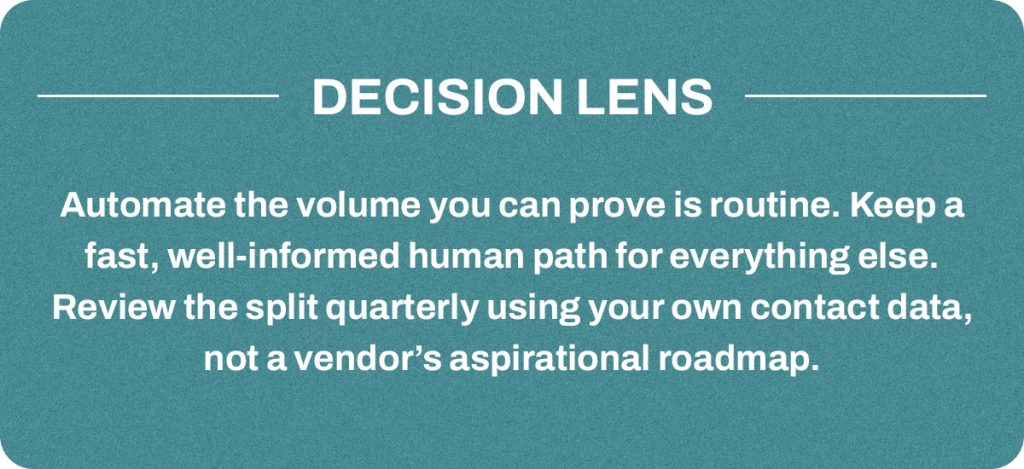
When a board member or a peer pushes on why automation isn’t moving faster, don’t reach for a defense of caution. Reach for the plan you’re already running: “We are matching automation to the volume that is actually ready for it, and we are proving that match with our own data before we scale it further.” That line does more work than a slide deck. It shows confidence without overpromising, and it invites the next question instead of shutting the conversation down.
Pressure Point Two: The Board-Level Headcount Mandate
This pressure point arrives from above, often stated in a single sentence: figure out AI so we can reduce headcount by a fixed percentage. It is rarely malicious. It usually reflects a board that read the same optimistic case studies everyone else read, delivered under real cost pressure of their own.
The instinct to say no outright is understandable and also unwise. The mandate is not going away because CX pushes back on principle. The job is to translate the mandate into something the operation can actually deliver without breaking service quality or staff morale in the process.
The evidence argues for translation over refusal. PwC’s August 2026 follow-up survey of 351 CEOs across fifty-nine countries found that only 39 percent said their companies maintained or improved a positive AI impact over the prior eight months, while 16 percent reported negative impacts, and more than half of CEOs in the broader late-2025 survey had realized neither revenue gains nor cost reductions from AI investment. I have watched boards absorb numbers like that and still hold the line on a headcount target, because disappointing results elsewhere do not erase the pressure on their own P&L. What moves a board is not a caveat. It is a credible plan with a realistic timeline and visible progress against it.
Questions to ask when a headcount mandate lands on your desk:
- What specific work, measured in hours or contact volume, is the mandate actually asking us to remove, and is that work currently done well by humans or poorly by an overloaded team?
- What is the realistic timeline for that volume to shift to AI without a drop in resolution quality or customer trust, based on our pilot data rather than a vendor’s projection?
- What would the board need to see at thirty, sixty, and ninety days to trust that we are moving, even if the full target takes longer?
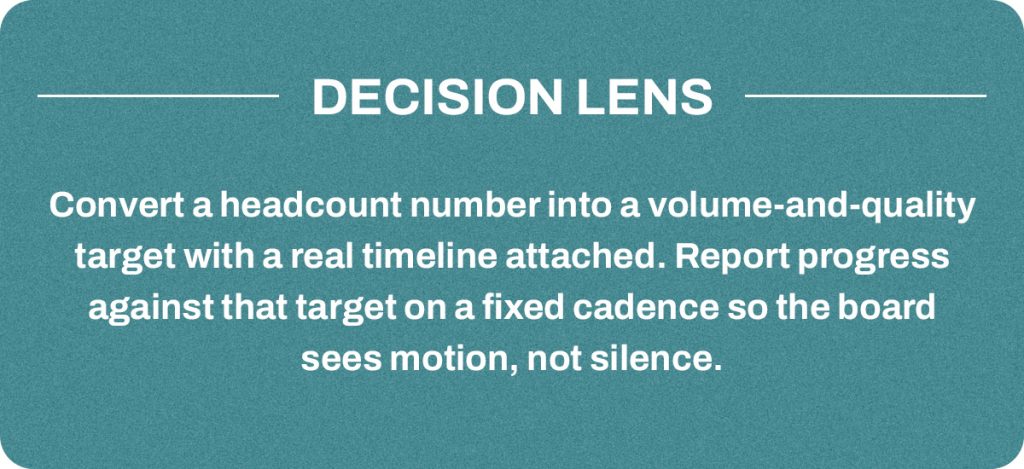
When the board pushes for the number itself, don’t argue the mandate away. Give them the sentence that reframes it: “We can commit to a clear plan that reduces cost as AI proves itself on real volume. We cannot commit to a headcount number detached from what the technology can reliably do today, because that gap becomes a customer problem within one bad quarter.” That line keeps you aligned with the board’s goal while protecting the operation from a commitment your evidence cannot back yet.
Pressure Point Three: The “AI Everywhere” Usage Target
This pressure point comes from inside the building. Someone sets a usage metric, adoption percentage, or number of AI-touched interactions as a success measure in itself. Teams start using AI to hit the number. Usage climbs. Nobody can say what actually improved.
This is the most avoidable failure mode on this list, and also the most common. I see it in nearly every account I work with that adopted AI under a usage mandate: dashboards fill up with adoption percentages, and no one can connect a single one of those percentages to a resolution time, a cost, or a customer outcome that actually moved. Usage targets built without a defined job for the AI to do are a leading cause of that pattern, because they reward activity rather than outcomes.

Questions to ask before setting or accepting any usage target:
- What specific job is this AI capability supposed to do, in one sentence a frontline manager would understand?
- What changes for the customer, the agent, or the manager if usage hits the target?
- If usage hits the target and nothing measurable improves, what happens next?
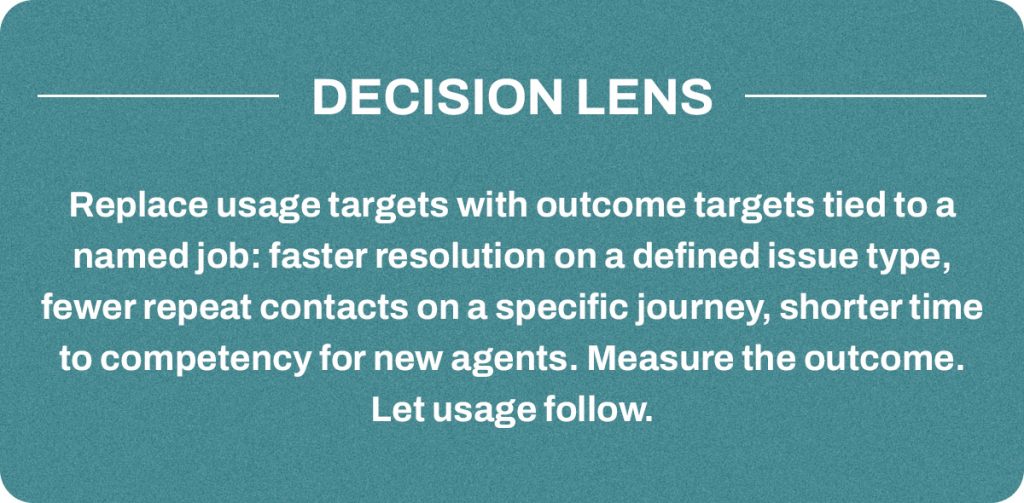
When someone asks why the adoption number isn’t climbing faster, resist the urge to defend it. Redirect to what actually matters: “We report on outcomes: resolution, cost, and the customer’s experience. If a capability earns its place there, usage follows naturally. We will not chase a usage number and hope the value shows up later.” That answer moves the conversation from a vanity metric back to the results the usage target was supposed to produce in the first place.
Pressure Point Four: The CRM Vendor Bolting On AI
The fourth pressure point is quieter than the others because it does not arrive as a mandate. It arrives as a feature already included in a renewal, framed as simplification. Several large CRM platforms have moved hard into this space over the past year, folding AI-driven contact center capability directly into suites that were originally built for sales and marketing data, not for the operational demands of a contact center. The pitch is consolidation: one system, one bill, one vendor relationship.
Consolidation is a legitimate goal. It is not automatically the right one for every operation, and the decision deserves the same rigor as any other AI proposal, not a pass because it arrived bundled with a system you already trust.
Questions to ask when a CRM-native AI feature shows up in a renewal conversation:
- Does this feature match the depth of a specialized contact center platform on the specific capabilities we rely on daily, such as workforce management, quality monitoring, or channel orchestration, or does it match the marketing slide?
- What do we give up in flexibility, data portability, or vendor leverage if we consolidate onto this feature?
- What is the actual switching cost, in migration effort and risk, if the bundled feature underdelivers eighteen months from now?

When a renewal conversation turns into a pitch for the bundled feature, say what you actually think: “We are open to consolidating where the capability genuinely holds up. We are not going to trade proven functionality for convenience without testing it against our own requirements first.” That answer keeps the door open to real consolidation while protecting you from trading a tool that works for one that only looks convenient on a slide.
The Standard That Holds Across All Four
Every pressure point above dresses up the same underlying test in different clothing. A vendor narrative, a board directive, an internal usage target, or a renewal conversation dressed as simplification: each one asks you to adopt an AI capability faster than your evidence supports. Run it back through the same three lenses from the start of this piece: what does this do for the customer, what does this do for the person doing the work, and what does this actually cost once you count every hour and every dollar.
Say no when the answer to any of those questions is genuinely unclear, and say it in language that names the specific gap rather than a general objection to AI; a specific gap is something a board, a vendor, or a colleague can act on. Say yes just as readily when the evidence holds up. The next pitch will show up wearing a different logo, and it will arrive sooner than this one did. Pick it up, run it through the lens, and answer before the room asks you to. That is the discipline that protects the thing AI is supposed to serve in the first place: an operation customers trust and a team that can do its best work inside it.