
Zoomtopia 2025: Zoom’s Bid to Redefine Customer Experience
At Zoomtopia 2025, Zoom laid out a vision for conversations as the engine of business progress. The announcements spoke directly to some of the most persistent challenges leaders face: missed handoffs between departments, insights that never turn into action, and customer experiences that lack consistency.
As I listened, what stood out was Zoom’s clear recognition of CX realities. They’re no longer the video company searching for relevance. Today’s event was about a platform stepping forward with a strategy to help organizations connect conversations, align teams, and deliver outcomes that matter.
Conversations That Become Outcomes
Leaders know the frustration of conversations that fade away before anything gets done. A sales call where insights never reach marketing. A customer escalation that closes without ownership. A strategy meeting where decisions vanish into inboxes.
Zoom’s AI Companion 3.0 is built to change that pattern. It tracks context, reasons through what matters, and takes action, whether that means drafting a follow-up plan, blocking time on calendars, or pulling insights from customer calls during an internal discussion.
The most intriguing piece is orchestration. Instead of waiting for a prompt, the system coordinates next steps proactively. Zoom is also extending flexibility with a Custom AI Companion add-on, giving organizations the ability to create tailored AI agents using prebuilt templates and low-code tools. These capabilities, expected to be generally available in November, reinforce Zoom’s push to move from assistive features into agentic execution.
That raises an important leadership question: how much autonomy should AI have in moving work forward, and how do organizations create the guardrails to balance speed with accountability?
Real-Time Support That Evolves
Contact centers often struggle to give agents consistent, useful guidance in the moment. Too much information is overwhelming. Too little leaves agents on their own. Zoom’s new Expert Assist aims to strike the balance.
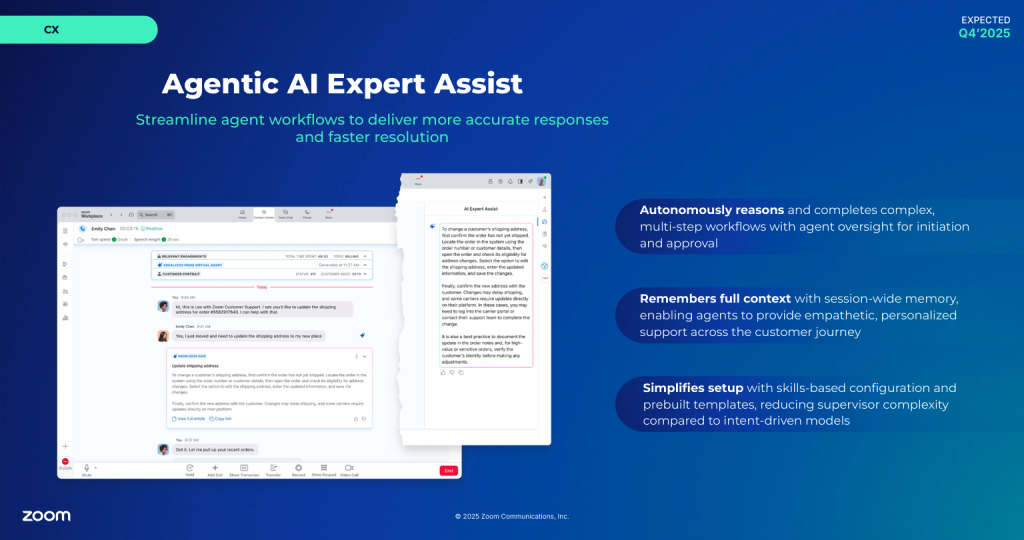
It uses memory and reasoning to follow the flow of the interaction, offering recommendations that adjust as the conversation evolves. This is exactly the kind of capability leaders are prioritizing. In our latest research, real-time guidance and next-best-action support ranked as the number one area for contact center AI investment in the year ahead. The appeal is clear: faster onboarding, fewer escalations, and more consistent outcomes.
The key question now is transparency. Leaders will want to understand why the AI makes certain recommendations so they can build trust and accountability into the process.
Analytics That Drive Decisions
Executives rarely struggle to find data. The real challenge is turning that data into action. Zoom’s new CX Insights promises to do just that. Leaders, supervisors, and frontline managers can query the system in plain language, surface trends, and receive prescriptive recommendations such as staffing changes or fixes to recurring self-service issues.
If the prescriptions hold up in live environments, CX leaders could spend less time debating metrics and more time implementing solutions. The potential is significant, but the real test will be how quickly the system adapts when conditions shift.
A Standard That Spans Every Interaction
Few customer journeys are purely digital or purely human anymore. They almost always blend the two. They move from a chatbot to an agent, from self-service to live support, often in the same journey. What they expect is not perfection in every channel, but consistency across the whole experience.
Zoom’s decision to apply the same scoring and compliance framework to both live agents and virtual agents speaks directly to that need. Quality cannot live in silos. It has to stretch across every touchpoint, no matter who, or what, delivers the service. Zoom is also adding new industry-tailored features, such as healthcare-specific templates and a “bring your own voice” option for its Virtual Agent, which allow organizations to create more personalized and consistent interactions. Integrations with Amazon Connect extend these capabilities into existing voice infrastructures.
For leaders, this creates alignment. Supervisors coach against a single set of expectations. Executives get a clear picture of performance across the operation. Most importantly, customers feel continuity rather than disjointed handoffs. That is the real test of progress: whether the entire system works together to deliver on the promise of the brand.
Meeting People Where Work Happens
Zoom also leaned into integrations. Service Cloud Voice, ServiceNow, Slack, and Teams are all gaining native AI capabilities powered by Zoom. These touchpoints matter because they are where work already happens. Leaders should watch closely to see if these integrations reduce effort or simply shift it. The promise is a more seamless flow of information across the systems that teams already rely on.

On the revenue side, Zoom Revenue Accelerator is gaining agentic prospecting skills that automatically scan event lists and lead sources, surface high-potential prospects, and initiate personalized outreach. For events, Zoom introduced features like “Ask AI Companion,” which lets attendees instantly catch up without disrupting the flow, and Production Studio in the Cloud for broadcast-quality webinars.
Alignment Becomes the Real CX Advantage
The theme running through Zoomtopia was alignment. Conversations feed insights. Insights become guided actions. Actions are measured consistently, regardless of whether handled by a person or a bot. And the entire process unfolds inside the tools teams already use.
This matters because misalignment across departments is often the root cause of poor customer experience. Marketing generates leads without visibility into service capacity. Sales commits to timelines without operational input. Service carries the weight of broken promises. What Zoom announced is a blueprint for stitching those functions together.
My Take
Zoom still has to prove these capabilities in complex enterprises, but the intent is clear. They are building a platform that connects productivity, customer interactions, and business outcomes.
For leaders, the path forward is straightforward: test these tools, measure the impact, and scale what works. The answers to many of the toughest business problems are already hiding inside conversations. The real opportunity is connecting, understanding, and acting on them, and that is exactly the ambition Zoom put on display.