
The AI Inflection Point in CX: How Verint Is Choosing Value Over Platform Wars
When private equity steps into a market, leaders expect disruption. When Thoma Bravo acquired Verint and joined it with Calabrio, every CX and contact center leader who relies on those platforms asked the same questions: Whose roadmap wins? Who gets left behind? What breaks next?
Verint’s answer has been blunt: none of that helps customers. Instead of a multi‑year platform consolidation, the company chose a different path. It pushed AI value out quickly, across both product lines, with as little operational pain for customers as possible.
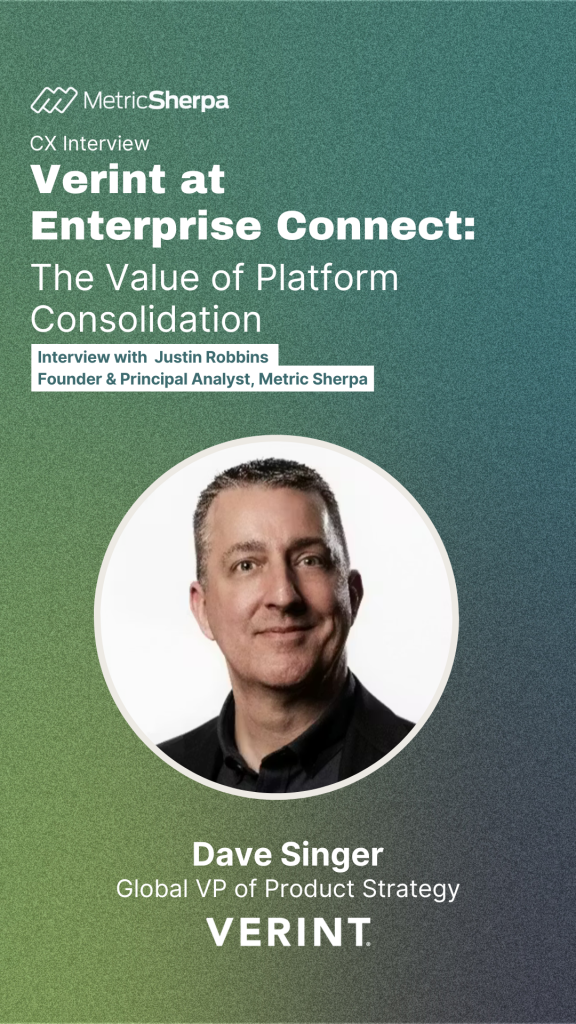
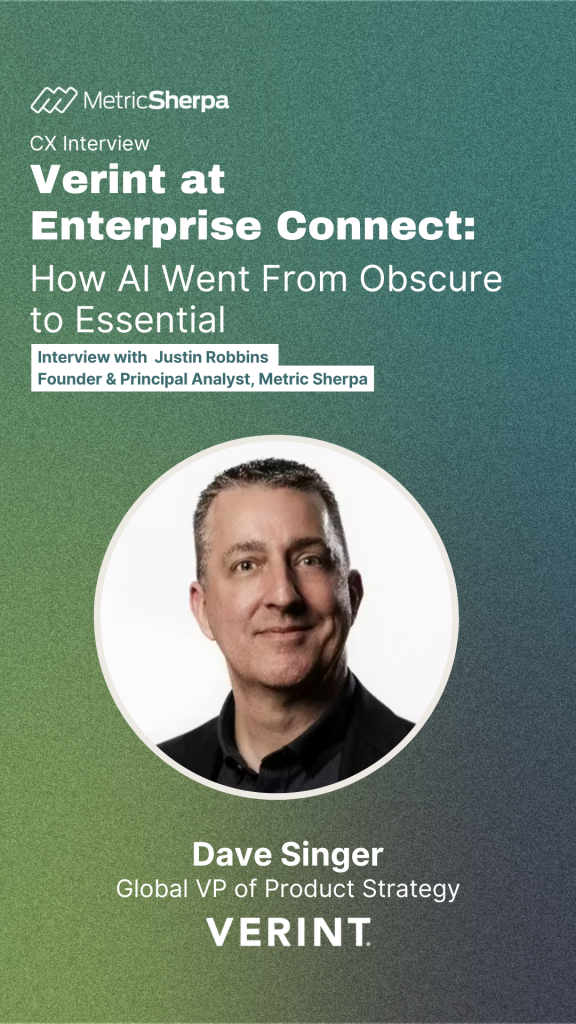
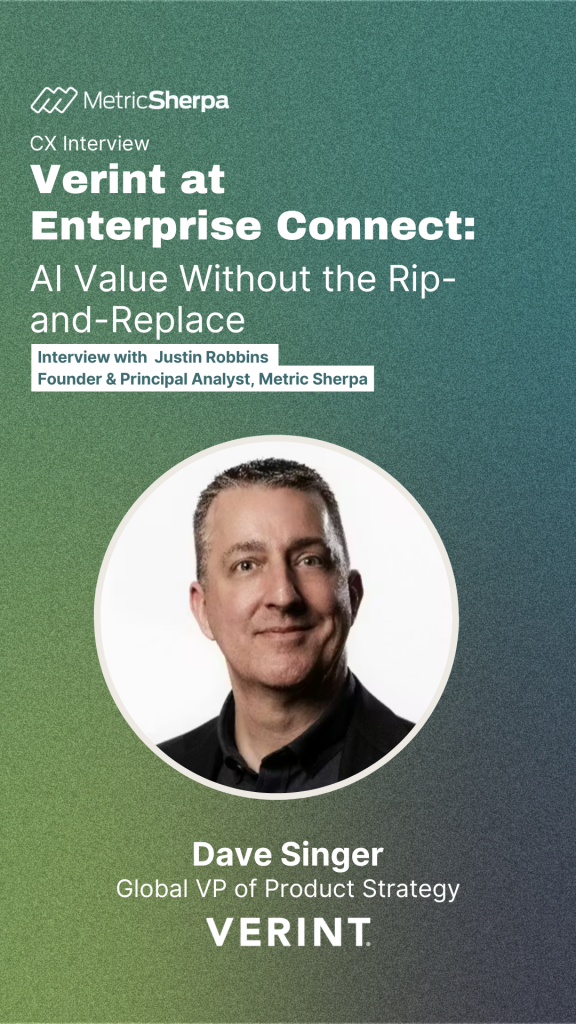
“It was never about picking a single ‘winner’ and forcing everyone to move,” says Dave Singer, Verint’s Global Vice President of Product Strategy. “That approach wastes years and annoys customers. Our focus is getting AI into production where it matters, without making leaders rip up what already works.”
From acquisition anxiety to AI access
In a typical consolidation, customers wait. They tolerate uncertainty while product teams debate roadmaps and branding. Verint and Calabrio moved in the opposite direction.
Instead of asking customers to migrate, Verint pushed its AI bots into the Calabrio environment and brought Calabrio’s strengths into the Verint platform, taking advantage of the open architecture both organizations had already built.
The result: existing customers on either side gain access to a broader AI portfolio without replatforming.
“Leaders tell us, ‘I don’t want a three‑year transformation. I want the value people keep talking about,’” Singer explains. “So we used the integration to remove friction, not add it. Same stack, more capability, less disruption.”
This matters because of the footprint involved. Verint already served a large share of complex enterprise environments, while Calabrio held strong positions in key regions and the mid‑market. Together, they now reach a broad cross‑section of global contact centers that span on‑premises, hybrid, and cloud.
For the leader running a 150‑seat operation and the one running 15,000 seats, the promise is the same: access to the same class of AI without having to “earn” it by buying into a massive migration first.
A 25‑year throughline: design for messy reality
This moment looks new because the acronyms changed. The underlying pattern has not.
When Singer joined Verint more than two decades ago, the company helped organizations capture and manage interactions across fragmented systems. It thrived in complexity instead of waiting for clean, unified environments to appear.
That design philosophy now meets an AI market crowded with contact center platforms from hyperscalers, CRM vendors expanding into service, and a long tail of niche AI tools. Many leaders feel boxed into a false choice: standardize everything on one ecosystem or risk falling behind.
Singer rejects that framing.
“Leaders look at the landscape and think, ‘Which horse do I bet on?’ It’s the wrong question,” he says. “You don’t have to rebuild your entire stack to get real value. You need to decide where AI actually improves the work, then integrate around that.”
Verint’s strategy follows that logic. It does not assume a single, perfect platform. It assumes an evolving mix of systems and focuses on using AI to orchestrate and elevate the work across them.
Where AI value shows up: dollars and lives
Most AI stories still stop at potential. Singer talks in terms of actual shifts in operations.
One example is Verint’s Interaction Wrap Up Bot. It uses generative AI to summarize calls and push structured notes into CRM and other downstream systems. Customers have used it to cut significant time off after‑call work at scale, freeing up capacity and reducing handle times without any new handle scripts or coaching programs.
The more surprising impact lands with people who previously struggled with this part of the job.
“We heard from agents who are dyslexic,” Singer recalls. “Wrap‑up notes were the most stressful part of their day. They felt exposed and constantly behind. Once the bot handled summaries, they could focus on the conversation. They stopped dreading coming to work.”
Scheduling tells a similar story. Verint’s TimeFlex Bot plugs into workforce management to let agents self-adjust schedules within guardrails, using AI to keep staffing levels healthy while giving employees meaningful control over their time.
Single parents, caregivers, and employees juggling multiple responsibilities suddenly have room to breathe.
“You get messages that say, ‘I can keep this job because I can shift my schedule around my kids,’” Singer says. “We talk a lot about the financial upside of AI. This is the part that stays with you. We’re taking friction out of people’s lives at the same time we’re taking cost out of the system.”
For leaders fighting attrition, burnout, and disengagement, that combination matters. It turns AI from a headcount threat into an experience lever: less pointless admin, more meaningful human work.
The only AI strategy that survives volatility
Ask any executive how AI shows up in boardroom conversations and you hear the same pressure: move faster. Do more. Show something. That urgency easily turns into a technology‑first push that backfires.
Singer starts in a different place.
“‘We need AI’ is not a strategy,” he says. “You need to start with value. Are you trying to lead in NPS, reduce cost to serve, improve agent experience, or protect revenue in peak seasons? Until you answer that, every AI discussion stays abstract.”
His first directive to leaders: define the outcome in concrete, operational terms. Then work backwards to use cases, data, and architecture.
The second directive acknowledges the only constant in AI right now: volatility.
The last few years brought a rapid shift from basic bots to large language models and now to more agentic patterns that chain tasks and decisions together. New capabilities appear faster than most organizations can redesign their processes.
“We have no idea what specific AI capabilities will be table stakes two years from now,” Singer says. “The only responsible move is to assume change and design for it.”
That means open platforms, clear APIs, and modular components rather than tightly coupled, monolithic deployments. It also means contract terms, governance, and operating models that assume incremental evolution instead of one big launch and done.
“Whether you work with us or another provider, don’t let your systems freeze your strategy in time,” he insists. “If your stack can’t flex, your roadmap is fiction.”
The leadership test hiding under the tech
Underneath the Verint–Calabrio story sits a broader question every CX and operations leader must answer: Do your decisions increase or reduce your room to maneuver?
Many organizations still run on a model where technology is fixed, process is rigid, and “agility” gets pushed onto frontline teams to improvise workarounds. Leaders push for transformation while their underlying systems quietly resist it.
The alternative looks closer to what Singer describes.
- Start from a clear definition of value, not from a list of features.
- Use AI to remove friction from both customer and employee journeys, not to bolt more complexity onto fragile processes.
- Treat open, adaptable platforms as risk management, not just as architecture choice.
That approach does not grab headlines as easily as a full replatforming or a sweeping “AI everywhere” declaration. It does something more important. It respects the reality leaders operate in: finite budgets, existing systems, and teams already stretched to their limits.
In that context, Verint’s posture after acquisition sends a message. It frames AI not as a reason to start over but as a way to move forward, one high‑value use case at a time, without giving up the ability to change course when the market shifts again.
Singer sums it up simply: “Our job is to make it easier for leaders to do the right thing for their customers and their people, without asking them to bet the company on a guess about the future.”
Clips