
Inside Glia Interact: What Happens When an Industry Actually Focuses
Most user conferences blur together. Sponsors compete for attention, customers trade pleasantries, and everyone leaves with more swag than substance. Glia Interact 2025 felt different. By concentrating exclusively on banks and credit unions, they created something increasingly rare in enterprise technology conferences: a community speaking the same language, solving the same problems, and sharing openly about what works.
I’ve attended enough vendor events to recognize when a company is running on momentum versus mission. Interact was a case study in what happens when a company commits to depth over breadth.
The Power of Vertical Clarity
Glia’s decision to focus solely on community financial institutions is unconventional in an industry obsessed with expansion. But that discipline is paying dividends. Every keynote, breakout, and hallway conversation centered on a common set of regulatory constraints, operational realities, and customer expectations. That shared context created sharper dialogue and faster connection.
I’ve seen plenty of cross-industry gatherings where conversations stall under the weight of generalization. Interact proved that focus breeds honesty. Attendees compared AI deployment timelines down to the week, shared scripts and routing flows, and openly discussed vendor consolidation. It was one of the most engaged crowds I’ve seen at a user event, and it was because the relevance was undeniable.
Vertical clarity does have tradeoffs. It limits the total addressable market and demands continuous innovation within a defined space. But it also delivers something the industry rarely achieves—community trust. The audience wasn’t there to be sold to. They were there to learn from each other.
From Tradeoffs to Liftoff
Glia’s CEO, Dan Michaeli, framed the company’s current chapter around a single idea: the end of the “efficiency versus experience” tradeoff. For decades, contact centers were forced to choose between lower costs and better service. Glia’s mission, he argued, is to erase that compromise through what he called “AI for All.”
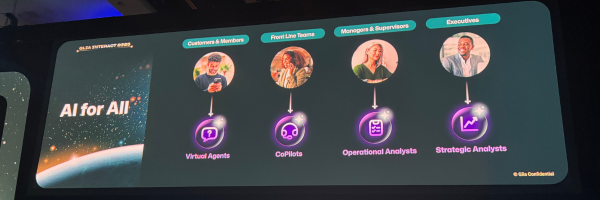
The metaphor worked because it was grounded in something tangible. Banking interactions still rely heavily on voice. According to industry data, over 70 percent of customer interactions happen by phone, even as chat and messaging adoption rise. Glia’s bet is that modernizing that experience—making voice AI as fast and natural as human conversation—will deliver both efficiency and quality simultaneously.
That’s an ambitious promise, and ambition needs evidence. To their credit, Glia offered it. Customer stories showed measurable improvements in service levels, resolution times, and agent workload reductions. Still, the broader question remains: can technology alone resolve the friction built into decades of legacy process and culture? The answer will depend less on product velocity and more on leadership discipline across the customer base.
A Conversation With Crystal Miceli
Two weeks into her new role as SVP of Brand and Product Marketing, Crystal Miceli sat down to share her early impressions. She was candid about what drew her in.
“Glia is exclusively focused on banks and credit unions,” she said. “That level of focus gives them the depth to truly solve problems.”
She described an environment where constructive challenge is encouraged—“a place where you can push for the best answer without it being a negative thing.” That cultural clarity shows up in product delivery. Unlike many SaaS companies that announce concepts years before they’re ready, Glia ships only production-ready features. Miceli sees that as a credibility advantage. “Customers are already using it, sharing tips, and driving results,” she said.
Her most memorable comment wasn’t about AI or marketing. It was about timing. “Latency is where frustration lives. It’s where customer loss lives. It’s where trust erodes.” That single line captured what many technology vendors overlook: in service, trust is measured in silence. Every millisecond of lag tells a customer whether they’re being understood or ignored.
Miceli’s read of the customer community was equally sharp. “They’re on a mission to serve their communities—to help first-time homeowners, fund education, and enable small business growth. We’re part of that mission.” That framing underscores why the vertical strategy matters. Shared purpose accelerates progress.
Voice AI: Proof Over Promise
Glia’s next-generation Voice AI dominated the headlines, but its real significance lies in the details. The system now responds twice as fast as competitive offerings, processes speech with near-human pacing, and integrates noise cancellation for real-world environments. More importantly, it was designed with “zero hallucination risk” for financial compliance—a distinction that matters in a regulated industry where misinformation is more than a nuisance.
The company’s approach to automation is pragmatic. The AI handles routine calls end-to-end but hands off complex cases to human agents with full context. That continuity—the customer never repeating themselves—is the real innovation. It’s also the kind of improvement customers can feel, not just read about.
Yet for all its technical merit, the challenge ahead is human. Sustained impact will require retraining staff, redefining success metrics, and integrating AI into coaching and quality programs. The best technology fails when culture stays static.
The View From the Data
Metric Sherpa’s recent research on contact center transformation, underwritten by Glia but independently produced, provides helpful context. In a study of 945 contact center leaders, 88 percent of whom are decision-makers, AI adoption is nearly universal, but maturity is uneven. Over 75 percent of contact centers use AI today, and 83 percent plan to expand in the next year.
Where leaders struggle is in alignment and measurement. Ninety percent rate customer value as extremely important, but only 60 percent measure it. Strategic value—the link between service operations and enterprise growth—ranks second in importance yet is tracked by just 27 percent. The disconnect between importance and measurement explains why so many AI investments underperform.
The data also revealed something encouraging. Forty-three percent of leaders plan to reinvest AI-driven savings into higher pay and better hiring standards. The industry narrative may focus on automation, but the leaders on the ground are betting on enablement. That choice mirrors what I heard repeatedly at Interact. AI isn’t about replacing people; it’s about amplifying them.
Focus, Friction, and the Path Forward
Glia’s greatest strength right now is its clarity of purpose. By anchoring in a single vertical and solving deeply for it, the company has earned both relevance and trust. That’s rare in a market full of horizontal platforms chasing growth at the expense of focus.
Still, clarity isn’t immunity. Sustaining innovation in a narrow domain requires constant reinvention and disciplined measurement of real outcomes. Latency reduction, contextual handoffs, and compliance-grade reliability are meaningful advantages today, but competitors will eventually catch up. What will differentiate Glia long term is how well its customers integrate these capabilities into their culture and metrics.
The broader lesson for CX and contact center leaders is simple: focus scales better than generalization. When everyone in the room shares the same stakes, conversations move faster, learning goes deeper, and innovation becomes communal. I saw that firsthand at Interact.
My Takeaway
The contact center’s definition is changing again—from a service function to a strategic engine of growth. Glia’s latest evolution fits squarely into that shift, but it isn’t the whole story. The real transformation will come from leaders who connect AI’s promise to operational truth.
Glia Interact showed what happens when an industry actually focuses. Conversations got real. Benchmarks got specific. Progress felt tangible. Whether Glia can maintain that edge will depend on its ability to keep shipping what works, not what wows.
For now, one thing is clear: focus creates connection, and connection drives confidence. The rest is execution.