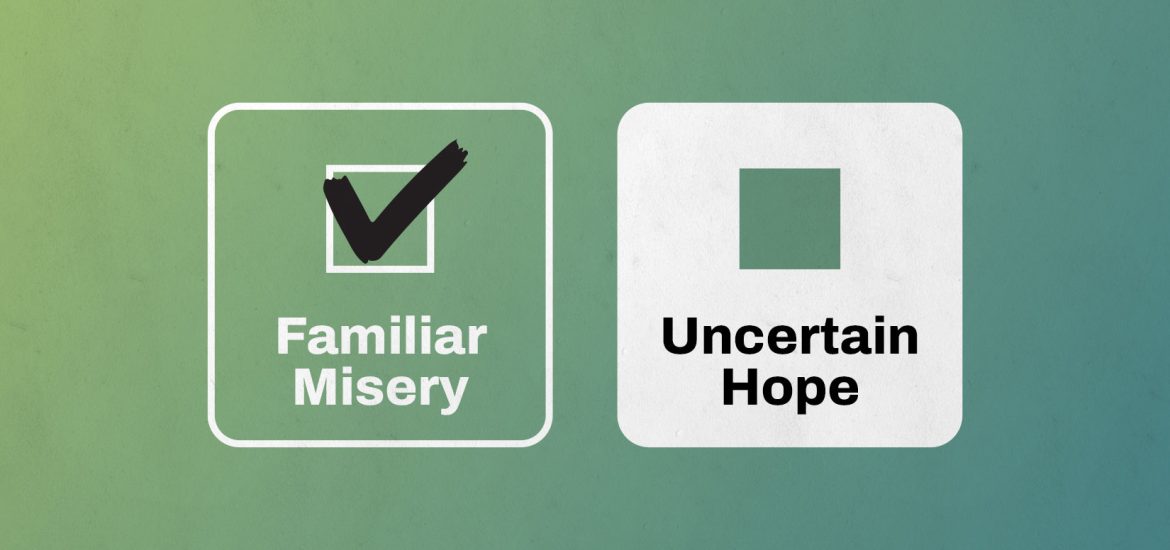

Familiar Misery, Uncertain Hope: The Readiness Gap Costing Leaders Their AI Investment
A mentor once told me that most times, most people will choose familiar misery over uncertain hope. I was reminded of that while moderating a panel at The Experience Show in Manchester last month. It’s a pattern I’ve watched play out more times than I can count. A leader knows an old process is broken. They choose it anyway, because the alternative feels like a leap into the unknown rather than a fix for something they understand.
As I watch organizations struggle to navigate their current environment and the impact of AI, that quote from my mentor captures the real barrier to AI transformation, and it has nothing to do with the technology itself. It has everything to do with whether leaders have done the organizational work required to make uncertain hope feel worth choosing.
I found it interesting, and affirming, that every one of my panelists in Manchester, across manufacturing, healthcare, and enterprise operations, converged on the same uncomfortable truth: the biggest obstacle to AI-driven transformation isn’t the maturity of the technology. It’s the absence of organizational discipline required to deploy it well.
Recognizing that distinction is critical, because most leaders are solving the wrong problem.
The Oversimplification Trap
One panelist, who leads digital and business optimization for a large healthcare organization, said it best. The biggest gap between how organizations talk about transformation and what actually happens, they told me, comes down to one thing: we make deployment sound simpler than it is. Senior leaders hear about a use case or a proof of concept and assume it can be dropped into the business cleanly. What gets missed is the ripple effect: how one AI deployment can change the entire experience, for the customer and for the employee doing the work behind the scenes.
They spread the blame evenly, and I think they’re right to. Vendors sell simplicity because simplicity closes deals. Leadership teams want one lever that cuts costs and improves the customer experience at the same time, because that story is easier to put in a board deck than the truth. The truth is that legacy systems, messy data, and years of undocumented workarounds sit underneath almost every customer touchpoint an organization wants to automate. Ignore that complexity and you get paralysis. The organization never built the runway the technology needed to succeed.
This is the pattern I think trade media and analysts should cover more aggressively. Vendors rarely overstate what generative AI or agentic AI can do in a controlled environment. What they leave out is what it takes to get an organization ready to use that capability in the real world. That readiness gap is where business leaders are losing time, budget, and credibility.
Redefine Success Before You Deploy Anything
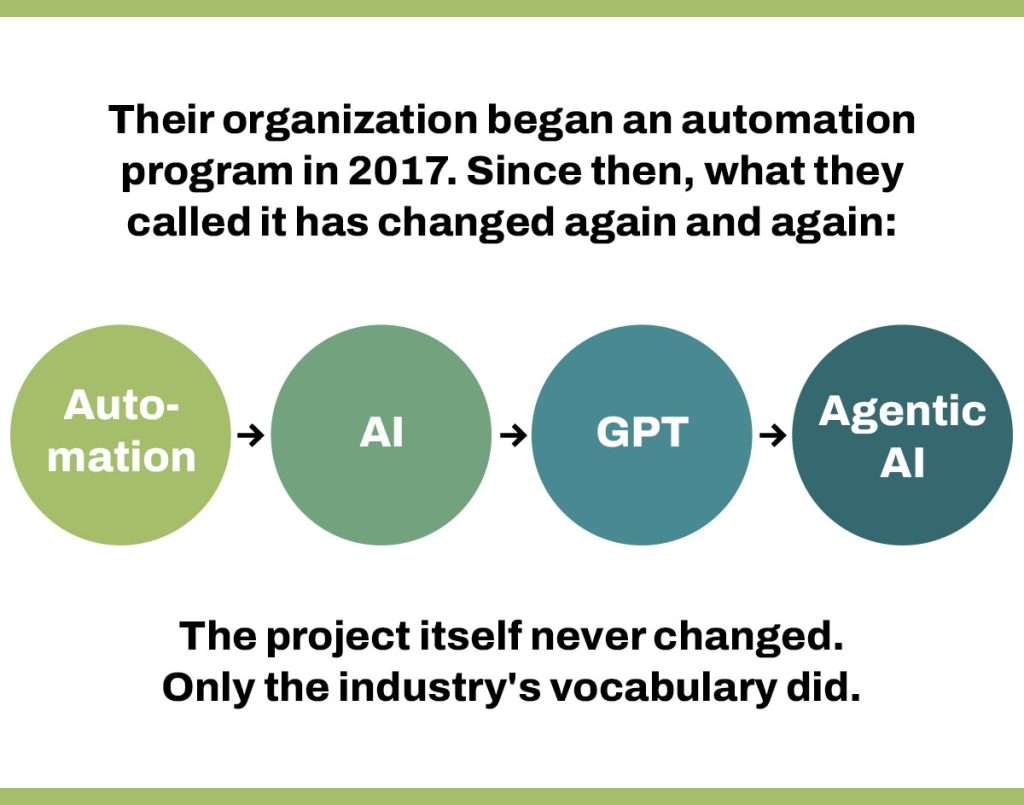
One of my panelists offered a case study that challenged attendees to rethink what it really means to launch an AI initiative. Their organization began an automation program in 2017. Since then, what they called it has changed again and again: automation, then AI, then GPT, then agentic AI. The project itself never changed. Only the industry’s vocabulary did.
What kept that program alive through eight years of shifting labels was one decision made at the start: define success broadly, and define it early. Cost savings were never the only measure. Quality mattered. So did giving people more headroom to think, rather than simply removing tasks from their plate. This panelist was blunt about a common reality many leaders avoid: the business case an organization starts with is rarely the one that ends up mattering most. The real value often shows up somewhere deeper than the one used to win the funding in the first place.
I take that as a direct challenge to how most AI initiatives get greenlit today. If your only success metric lives in a cost-reduction spreadsheet, you’ve already limited what the initiative can become, and set yourself up to defend a small win instead of chasing a bigger one.
Build Fluency, Not Just Capability
The most useful advice came from a panelist who talked less about the technology and more about whether the organization actually understood it. AI initiatives fail, they argued, when organizations skip the work of figuring out who needs to know what. The experts doing the work need deep knowledge. The people handling the task day to day need a working knowledge. Directors and sponsors need enough understanding to know exactly what capability they’re funding, and whether the organization is actually ready for it today.
In my experience, that last point is the one leaders skip most often. A sponsor who cannot explain what capability a project will actually deliver is offering cover disguised as oversight. And an organization that hasn’t checked its own data quality isn’t ready for AI, no matter how urgent the mandate from above feels. Wanting a capability and being ready to use it are two different things. Mixing them up is how transformation budgets get spent on tools nobody can actually run.
The same panel raised a tension many leaders feel but rarely feel able to address: pressure from above to cut cost collides with what frontline leaders see at the customer and employee level, which is friction, not efficiency. The advice was to turn that observation into business terms and bring it forward, rather than sit on it to avoid looking difficult. Show what the capability was supposed to deliver, show what the data and readiness actually support, and show the gap between the two. That’s simply the job.
Know Where the Human Still Wins
Before you decide where AI belongs in your operation, consider this perspective from a manufacturing study shared during one of the panels. People can only hold sharp focus for short bursts. But human accuracy still beats AI accuracy in a lot of tasks, because AI is trained by humans, and it can’t exceed the ceiling of what it was taught.
That tells you something important: get precise about where AI belongs and where people should still do the heavy lifting. The organizations getting this right are making that call on purpose, deciding where AI adds capacity and where people still make the difference. Then they find champions who can carry that message through the rest of the organization. Resistance to change isn’t a flaw in your people. It’s a rational response to uncertainty leadership hasn’t resolved yet.
One Place to Start
Strip away the branding, and every AI conversation comes down to the same question: is your organization ready to use this, and have you defined success as more than a number on the cost line?
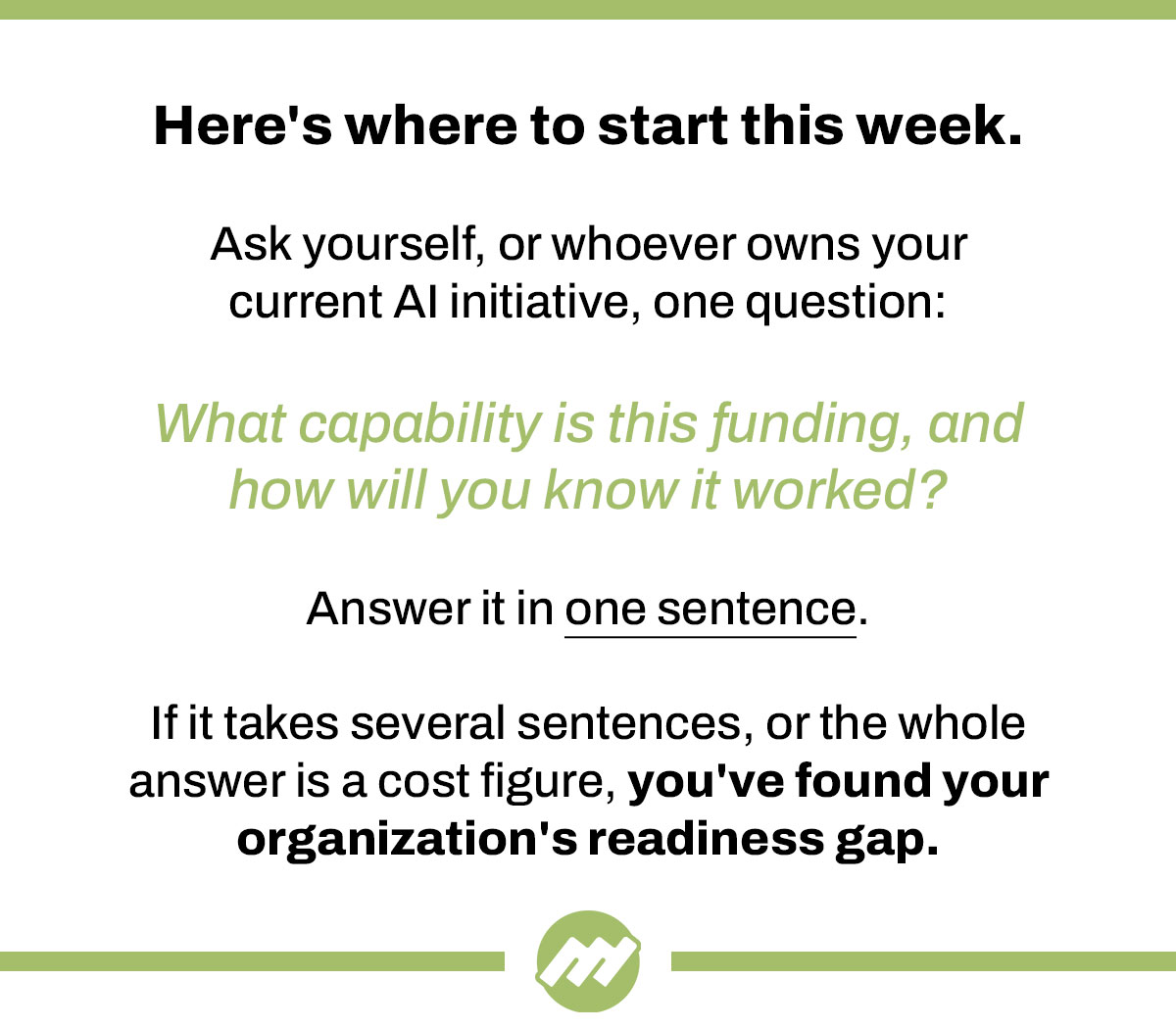
Here’s where to start this week. Ask yourself, or whoever owns your current AI initiative, one question: what capability is this funding, and how will you know it worked? Answer it in one sentence. If it takes several sentences, or the whole answer is a cost figure, you’ve found your organization’s readiness gap.
Then close it. Define success as more than a cost number, confirm your data can actually support what you’re promising, and give your frontline leaders a real way to flag friction without paying a credibility tax for it.
Next, map who needs to understand what before you scale anything further. Your experts need deep fluency in the tool and the problem it solves. Your frontline teams need working knowledge, not a training deck they forget by Friday. Your sponsors need enough understanding to defend the initiative in a room without leaning on a vendor’s slides to do it for them. Skip this step and you get exactly what shows up eighteen months into most AI programs: a promising pilot that quietly stalls because nobody below the announcement actually knew what they were running.
Do that work and the technology becomes the easy part.
Familiar misery is comfortable. Uncertain hope only becomes worth choosing when leaders put in the work to earn it. That’s the job in front of you now.