
Your People Problems Are Design Problems
Why good teams lose clarity, trade-offs, connection, and capacity under pressure
In this article:
- When nobody knows what has to win. Why “everything is important” leaves teams unable to decide.
- When priorities vanish under pressure. How leaders reveal the real standard through the trade-offs they protect.
- When capable people stop bringing their best thinking. Why people withhold insight when their judgment changes nothing.
- When “just push through” becomes the plan. Why permanent urgency exposes a capacity and work-design failure.
- RHYTHM Operating System. These four conditions belong to a broader leadership model for making work work.
The core question: before asking people to work harder, take more ownership, or become more resilient, what is the work asking them to overcome?
It is 9:40 on a Tuesday morning, and Dana already has two answers she cannot give.
Dana manages a thirty-eight person support team. One director wants the backlog cleared before the quarterly review. Another wants every escalation handled by a senior rep, and the senior reps are the only people fast enough to clear a backlog. Both requests arrived within nine minutes of each other, both from people who outrank her, and neither director knows the other one asked.
So Dana becomes what the org chart never named her: translator, negotiator, shock absorber, and part-time magician. She decides which request gets answered first, which standard bends, and whose frustration creates the most immediate problem. She will make that call roughly forty times before Friday, and no one will document a single one.
Dana is a composite. Managers in her seat run support desks, clinical units, field operations, and marketing teams, and they all recognize the Tuesday morning.
The work still gets done. It takes too many meetings, too much manager translation, and a few people quietly carrying more than they should.
Then someone in a leadership meeting says the familiar things.
“We have an accountability problem.”
“People need to step up.”
“The team is disengaged.”
“Managers need to communicate better.”
Before asking people to do more, look at what the work asks them to overcome. What leaders read as a people problem usually starts as a work problem. Four conditions produce most of them.
When Nobody Knows What Has to Win
When people keep asking what matters most, they are asking for the authority to make the next decision.
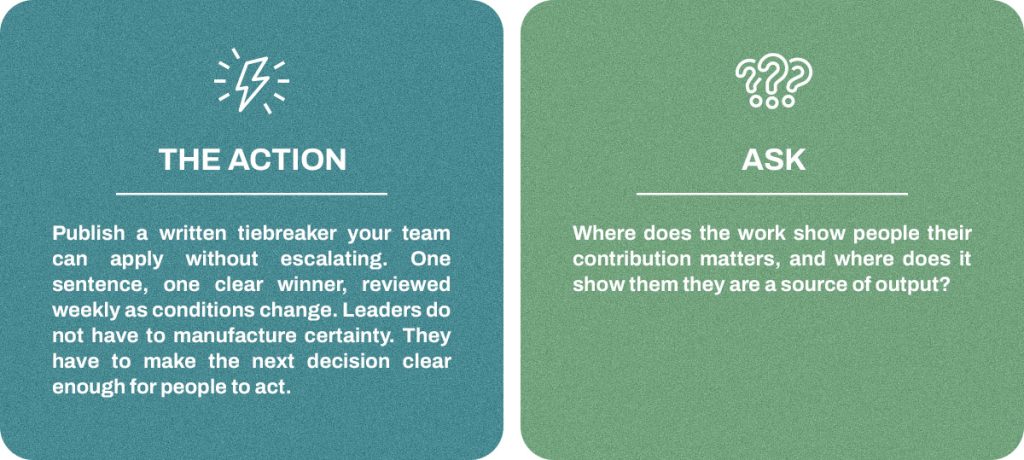
The signs repeat across every operation. Work slows while people wait for direction. Managers restate the same priorities in every meeting. Two leaders send requests that both sound urgent. Someone asks which one comes first, and the answer arrives as some version of “everything is important.”
Strategy that sounds clear in a presentation breaks down the moment competing demands force a choice. Managers like Dana sit at that break point. Their teams ask what should happen first, and the honest answer is that they lack clarity too. Honest, and still unusable. The team needs a way to move.
Gallup has tracked that gap for a decade. In the first half of 2026, 49 percent of employees strongly agreed they know what is expected of them at work, well below the 61 percent peak in 2015 (Gallup). Half the workforce arrives each morning without a clear answer to the question Dana’s team asked her. The cost of the resulting churn lands on management: ineffective decision making consumes more than half a million days of manager time at the average Fortune 500 company, roughly $250 million a year in salaries (McKinsey).
People protect themselves when nobody names the winner. They wait. They escalate. They serve the loudest request and choose the safest option available. Customers then get different answers depending on who happens to pick up the issue, and the team loses confidence in its own judgment.
Eventually every team reaches the moment when two reasonable priorities cannot both win. That moment shows whether clarity holds under pressure.
When Priorities Vanish Under Pressure
Organizations say quality matters, customer experience matters, people should use their judgment, and the new way of working stands as non-negotiable.
Then volume spikes. A deadline moves. A senior stakeholder needs something immediately. A budget tightens.
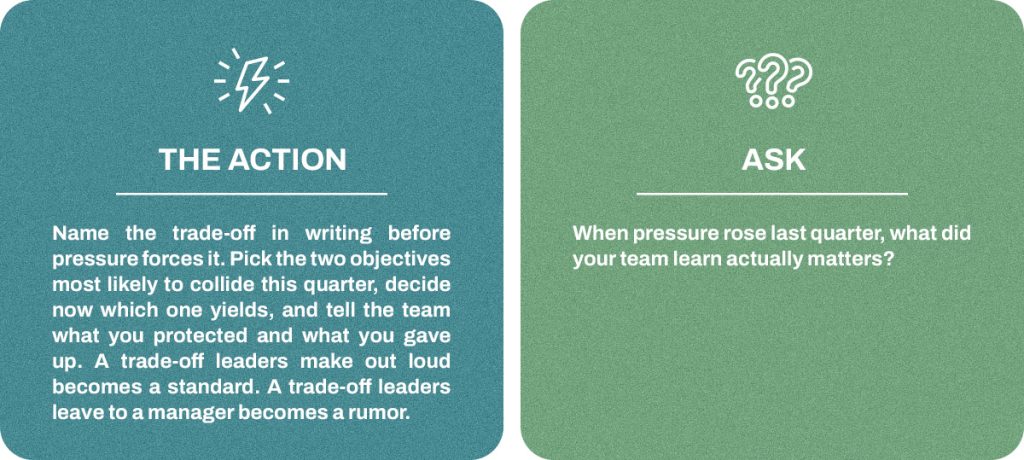
Someone has to decide what gives, and that someone usually holds the least room to make the call. Leaders tell managers like Dana to protect quality and move faster, to improve the customer experience and reduce cost, to support the team and deliver more with fewer people. Those managers negotiate the trade-off the organization refused to resolve.
Teams learn what really matters by watching what leaders protect when pressure rises. When speed always beats quality, speed is the real standard. When a customer promise disappears as volume climbs, the promise is conditional. When leaders praise managers for absorbing impossible demands without changing anything, survival becomes the operating model.
Gartner found that 77 percent of employees regularly face cultural tensions, competing imperatives they cannot reconcile in day-to-day work (Gartner). During significant change, that share climbs above 80 percent (Gartner). Those tensions do not resolve themselves. Someone with less authority resolves them, quietly, one decision at a time.
The pattern shows up as inconsistent follow-through. Teams launch initiatives and abandon them when the next urgent request lands. Standards drift. Values turn situational. Nobody intends this outcome, and good intentions leave the trade-off in place anyway.
When Capable People Stop Bringing Their Best Thinking
Disengagement rarely announces itself. It shows up as a change in how people participate.
People stop offering ideas because nothing changes. They stop volunteering because extra effort earns more work. They go quieter in meetings. They follow a process they can already see will fail.
From the outside, that reads as low motivation. Inside the work, it functions as self-preservation.
Capable people pull back once they learn their judgment carries no influence. They raise an issue and never hear what happened next. They offer an idea and watch it vanish into the same silence as the last three. When people see leaders ignore initiative, override it, or reward it with more work, they adapt.
Gallup reports that only one in four employees worldwide strongly agree their opinions count at work (Gallup). Gallup also documents exactly how organizations produce that number. One client sent a companywide survey asking employees for new product ideas, collected more than 9,000 responses, and did nothing with them for months.
Connection determines whether people keep bringing judgment to the job. People contribute care, insight, and initiative when they can see their effort move something. Leaders do not have to approve every request. Leaders have to close the loop: confirm what they heard, name what they decided, and explain what changed.
A team that stops offering judgment loses its ability to adapt. Improvement slows. Managers carry more of the thinking. Customers feel the distance through rigid processes, unnecessary handoffs, and people who have no energy left to solve the problem in front of them.
What teams work around internally, customers experience externally.

When “Just Push Through” Becomes the Plan
Teams stretch. They handle a surge in demand, rally around a difficult customer issue, absorb a major launch, and recover from an unexpected disruption.
Trouble starts when the stretch never ends.
Resource-constrained teams hear “do more with less” from a leader chasing a budget target, from a transformation initiative, or from an executive who owns an objective disconnected from what the team can carry. A team already missing expectations receives less capacity and more work, and leaders still expect its manager to protect quality, support morale, hold customer outcomes steady, and keep performance flat.
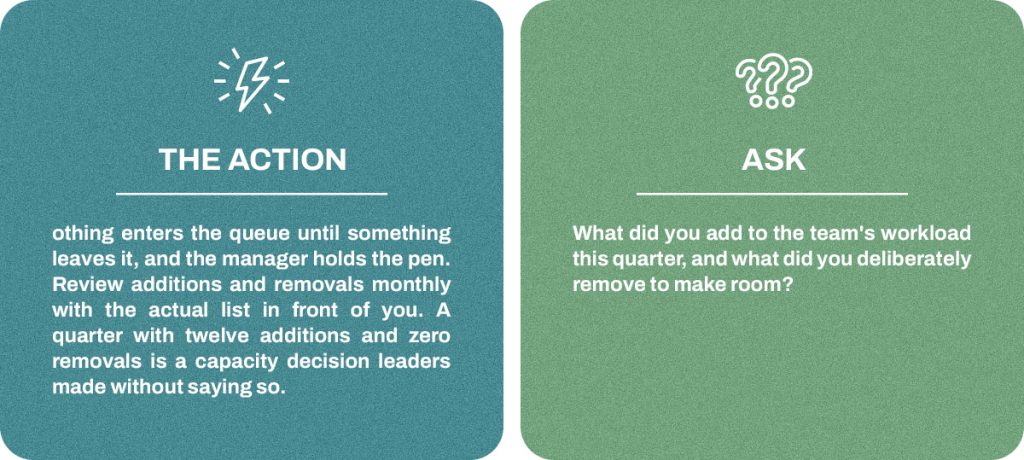
Something gives. When nobody makes the trade-off visible, the team makes it quietly. People work later. They skip the reflection and improvement work. They stop asking whether a process makes sense because they are too busy surviving it. Quality slips. Curiosity goes first.
Then leaders ask why people show so little resilience. Wrong question. A team sprints for a period. No team builds sustained excellence on permanent urgency.
Pace reflects decisions. Every new priority, deadline, and quick ask decides what the team carries. When leaders skip that choice, customers pay for it with slower answers, more errors, more handoffs, more effort, and less room for the team to do its best work.
The Work Behind the People Problem
When demands keep expanding while capacity, priorities, and process stay fixed, the work no longer supports the people doing it. Teams still need capable leaders, clear expectations, sound judgment, and accountability. Those requirements sit on top of the design, and the design decides how much of each one survives contact with a Tuesday morning.
Back to that Tuesday. At 4:50 Dana picks one director’s request, protects one standard, and disappoints someone. She does it well, because she is good at her job. She also does it alone, with no record and no support, and her team reads the result as the company’s real position on what matters.
Somewhere along the way, work started working against people. Leaders who create clarity, protect trade-offs out loud, make contribution visible, and set a sustainable pace hand that Tuesday morning back to their teams. The judgment returns. The customers feel it. The momentum lasts.
See the Full Operating System
These four conditions belong to a broader leadership model. The RHYTHM Operating System turns them into a repeatable way of designing work, with six conditions that translate purpose into the daily decisions, experiences, and operating habits shaping both employee and customer outcomes.
Download the RHYTHM Operating System to explore:
- Resolve What Matters
- Hold the Line
- You Belong Here
- Tempo the Work
- Hear the System
- Make It Repeat