

Operationalizing Voice of the Customer
This piece represents a joint effort from Nate Brown and Justin Robbins. Together, they explored what it takes to turn Voice of the Customer (VoC) from a listening function into a practical management system. The ideas and examples that follow reflect their shared experience helping organizations connect customer insight with daily operations.
Every organization claims to listen to customers. Few actually design their business to respond.
Voice of Customer exists to close that gap. When executed well, it becomes the feedback engine behind strategy, innovation, and daily execution. It reveals what customers value, what frustrates them, and what causes them to leave. Then it translates those insights into decisions that make life easier for both customers and employees.
VoC work has also changed. New listening channels, analytics, and process disciplines make it possible to hear customers in more places and with more clarity than ever before. Many teams still run 90s‑era VoC, centered almost entirely on lagging surveys. The opportunity now is to step into modern VoC without waiting for a massive technology overhaul.
Companies that operationalize VoC outperform because they stop guessing. They let the customer’s truth shape each next step. Yet most organizations never reach that point, because their VoC efforts stall out long before feedback reaches real decisions.
Why Most VoC Programs Stall Out
Most VoC programs fail because teams direct energy toward the wrong priorities.
Organizations build impressive listening infrastructure with survey tools, text analytics, and sentiment dashboards. Too often, those sit disconnected from digital indicators such as feature usage, drop‑off points, and app performance, so no one sees the full context. Data flows in, yet little action follows. This happens when listening sits outside of planning, budgeting, and performance goals. Leaders overspend on listening tools and underinvest in the systems and habits that turn insight into change.
Feedback that does not influence decisions quickly loses credibility. Employees start to see listening as a formality that does not change how they work.
Here is where the breakdown occurs most often and how to fix it.
Listening without intent. Collecting every possible opinion creates confusion. Start with one clear question: What decision will this data influence? Designing feedback channels around decisions keeps the work grounded in outcomes instead of activity.
Insight without ownership. VoC teams surface valuable findings but often lack authority to act. Correct that by assigning owners for each major customer issue. Treat feedback as a portfolio. Every item has a sponsor, a plan, and a timeline.
Reporting without reflection. Metrics gain value only through conversation. Hold regular “customer calibration” sessions to interpret recent feedback. Ask: What changed? Why? What is next? Turning data into dialogue sets a stronger expectation for learning and accountability.
Progress begins when an organization captures, distributes, and responds to feedback through consistent, repeatable habits. That consistency builds both internal trust and customer loyalty. The next step is to understand where your current VoC program sits today so you can focus on the right changes.
The VoC Maturity Curve
VoC programs across industries follow the same growth path. Knowing your stage clarifies which challenges require focus next.
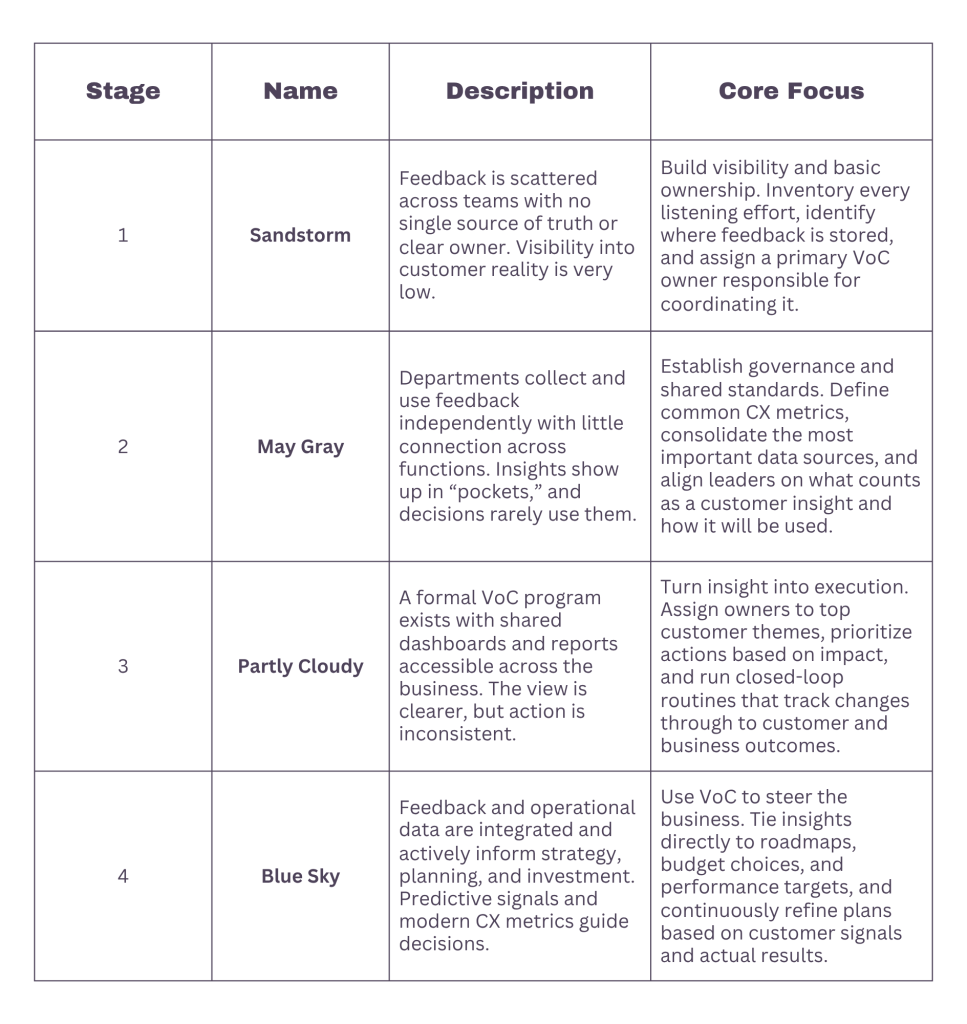
Reaching the higher stages depends on speed, clear ownership, and steady coordination between what customers share and what leaders choose to do. This transformation begins with a leadership mindset.
Your First 30 Days as a VoC Owner
If you are responsible for VoC today, treat the next month as a reset window.
- Week 1: Take inventory. List all active listening efforts: surveys, reviews, advisory boards, support channels, product analytics, in‑app prompts, and community spaces. Note who owns each one, where the data lives, and how often it is reviewed. Mark obvious overlap and gaps.
- Week 2: Place your program on the maturity model. Use the table above with a small cross‑functional group. Agree on your current stage and pick one “core focus” item as your top priority for the next two quarters.
- Week 3: Build your first listening path map. Choose one key persona and one journey. Map stages, existing listening posts (including digital telemetry), and behavioral signals. Highlight the top three blind spots where you lack signal entirely or rely on anecdotes.
- Week 4: Assign owners and actions. For your top three customer themes, name an executive owner, define a specific action, and commit to sharing visible progress back to the business in 60 days.
This simple sequence turns the ideas here into a practical starting blueprint, without waiting on new budgets or tools.
How Leaders Make VoC Matter
For VoC to matter inside an organization, leaders must create space for customer truth. Leaders who believe they already have the full picture rarely leave that space open.
Executives who treat customer feedback as strategic intelligence multiply their impact. They model curiosity, explore what signals mean, and reward teams that act on insights. Education often kicks this off. Senior leaders need to see how VoC links directly to financial performance, retention, and growth.
Practical techniques to build belief and urgency:
- Connect simplicity to growth. Use the idea of “ease of doing business” to show how reducing friction grows revenue and lowers cost to serve.
- Use “wild sentiment.” Bring unfiltered feedback from reviews, forums, and social channels straight into executive conversations. Real customer words cut through debate and show what people feel in the wild.
- Highlight the cost of not listening. Translate churn risk, lost expansion, and high acquisition costs into real numbers. Position VoC as the primary way the organization understands why customers leave and how to keep them.
To strengthen leadership engagement in ongoing work:
Anchor customer input in strategy sessions. Bring recent VoC learning into quarterly reviews and planning cycles. The customer’s perspective deserves a seat beside financial and operational data. When leaders weigh both, confidence rises across the organization.
Build curiosity rituals. Simple acts, listening to customer calls, reading a few open-ended comments each week, or joining frontline meetings, keep decision-makers close to the experience they manage. These habits create a direct line between leadership conversations and customer reality.
Connect listening to value creation. Every measurable improvement should trace back to the feedback that inspired it. This practice reinforces that listening drives tangible success and encourages teams to keep surfacing insights.
When leaders engage personally, customer empathy becomes a working skill, not a slogan. Once that mindset is in place, the organization needs a system that can carry it into everyday work.
Building the System Behind the Listening
VoC requires a system that handles structure, ownership, and flow.
A mature system rests on three pillars: governance, integration, and follow-through.
Governance. Assign an independent program owner who oversees all listening work. This leader manages priorities, data integrity, and accountability. In many organizations this sits with a CX leader, but it can also sit in marketing or product as long as the role has “journalistic integrity” and can represent the customer’s truth across silos.
Integration. Merge data from service, marketing, product, and digital analytics into one shared environment. When everyone sees the same customer reality, alignment follows. Support this owner with a cross-functional group of leaders from critical touchpoints. Their job is to bring requests into the VoC program and take insights back out in ways their teams cannot ignore.
Follow-throughEach insight should have a defined path from discovery to implementation. Track how feedback drives changes in operations. Visible traceability protects the program’s credibility and keeps leaders invested.
Real organizations already operate this way. CVS, for example, built a centralized VoC environment accessible to tens of thousands of associates. They use evolving personas driven by live feedback to guide how they support customers. In that environment, VoC sits at the heart of the mission, not on the edge of it.
Working Through Turf and Trade‑offs
VoC leaders often understand what needs to happen long before the rest of the organization is ready. The hard part is rarely the framework. It is competing priorities and internal friction.
Three practices help break through:
Frame in terms of shared goals. When teams resist sharing data or changing workflows, translate VoC into their language. Connect a specific insight to their targets, such as renewal, product adoption, or cost to serve.
Start with one cross‑functional win. Do not try to fix every journey at once. Pick one high-visibility problem, use VoC to solve it with partners from multiple teams, and then tell that story widely. A visible win softens resistance faster than repeated reminders.
Use executive air cover deliberately. When you face persistent blockers, bring a small set of clear, prioritized asks to your executive sponsor. Ask them to remove one barrier at a time rather than to “support VoC” in general.
Power and politics never disappear. The goal is to use VoC to create shared wins that make collaboration the rational choice.
When VoC runs as a structured business system, momentum builds naturally. Leaders see results. Employees see meaning. Customers see progress. To design that system thoughtfully, teams need a clear picture of where and how they listen today.
Mapping Your VoC Listening Paths
A listening path map helps identify both overlap and blind spots.
Choose one key customer persona. Then:
- Map every stage of their journey.
- Identify known listening posts, such as surveys, call logs, reviews, in‑product feedback, and communities. Include both structured sources (formal surveys, advisory boards, customer councils, in‑app prompts) and unstructured sources (social reviews, forums, contact center conversations, app store reviews).
- Add behavioral evidence such as cancellations, repeat purchases, or repeat contacts.
- Highlight stages with no data or limited knowledge.
Here’s an example of a high-level listening path map:
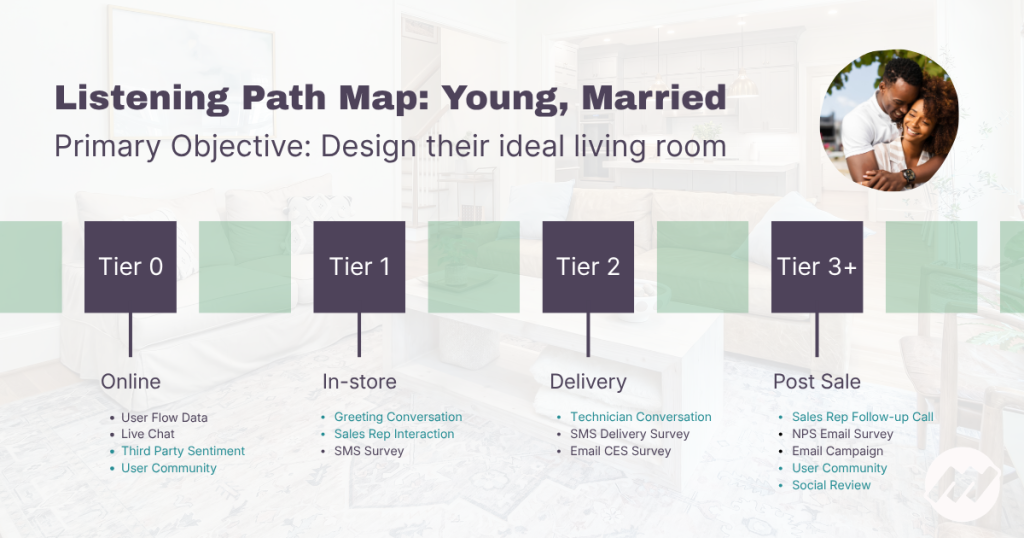
That map becomes a diagnostic tool. It reveals where new listening posts or better analysis will deliver the biggest insight gains. It almost always exposes large holes in the listening engine.
Different moments require different feedback styles:
- Early journey: monitor social and community channels for expectations and motivation.
- In‑use stage: analyze support interactions for pain points and friction.
- Post‑purchase: use advisory panels or customer councils to understand loyalty or attrition patterns.
- Digital experience: study product analytics, feature usage patterns, and error rates to spot friction before customers ever file a complaint.
Run this exercise with the cross-functional VoC team. Doing it together prevents “VoC in pockets” and keeps attention on the real journey, not internal org charts. Repeating the exercise across multiple personas keeps the organization tuned to reality as markets change. With that map in hand, technology decisions become much clearer.
Modernizing the VoC Tech Stack
Technology sustains the listening effort, but purpose drives the value. Evaluate every platform against three questions:
- Does it help the organization decide faster?
- Does it connect people who must respond?
- Can it show measurable business impact?
High-performing VoC environments share three technical traits:
Connected data. All feedback routes through a single, accessible environment tied to CRM, product analytics, and service systems. Customer narratives and digital behavior sit side by side.
Insight generation. Analytics tools surface priorities by volume, intensity, behavioral impact, and cost. AI assists with speed, surfacing patterns such as drop‑offs in key flows or features that correlate with churn, and then humans decide what matters.
Execution tracking. Workflow tools record how insights lead to operational changes. This tracking converts transparency into trust.
Newer capabilities such as digital twins and synthetic data can also model how changes in experience might affect behavior before they roll out broadly. The most important point remains simple: Technology should operationalize learning and eliminate delay between hearing and helping. When the mindset, system, and tools all work together, the impact becomes visible across the business.
What a Mature VoC Delivers
A mature VoC system creates agility. When customers signal a shift, the business adjusts ahead of the curve.
- Product teams prototype based on verified feedback.
- Service teams address the root causes of effort and dissatisfaction.
- Marketing teams build messages grounded in perception data.
Responsiveness compounds trust. Customers feel seen. Employees take pride in progress they can trace directly to customer voice.
Organizations that sustain this capability earn faster learning cycles, lower risk, and a stronger grasp of what creates value.
From Listening to Running the Business
Operationalized VoC turns listening into a management discipline.
Clarify the purpose of feedback. Connect listening directly to the decisions it informs. Build a structure that links insight to action, and assign clear ownership for execution.
The result is a real-time feedback engine that keeps the business synchronized with its customers.
In a market that evolves daily, that alignment is the ultimate competitive advantage.