
Balancing Speed and Connection In Customer Interactions
Contact center leaders are being crushed.
Executives demand faster results, happier customers, and shrinking budgets. It’s a high-stakes juggling act—chasing efficiency without sacrificing connection. But what if the problem isn’t the pressure itself…it’s how we define success?”
Too often, our attempts to demonstrate success as a service function are overly-focused on cost reduction and efficiency. This can be a hard trap to escape. In helping to establish multiple contact centers, there is one especially powerful method I’ve used to transcend efficiency quicksand – to measure the larger strategic value of meaningful customer interactions.
Unfortunately, the concept of “value” can be difficult to measure. The vast majority of common metrics we use to measure customer service / contact center performance are insufficient or misleading:
- Average Handle Time (AHT): Tells us how quickly we handled an interaction, but not if the interaction was helpful or valuable.
- Customer Satisfaction (CSAT): Gives you a general idea of customer sentiment, but often fails to illuminate actionable insight or correlate to loyalty.
- Cost Per Contact: The pinnacle of “efficiency” thinking if not balanced with other data points. Only validates the cost to support customers but lacks perspective on the broader benefits and impacts of supporting customers well.
The bottom line is that if we focus too much on customer happiness or too much on efficiently, we end up missing the mark.
Here is the big shift: “Make the quick parts quick and the slow parts meaningful.”
It’s not about doing everything fast. It’s about being strategic with the time you have.
When recently building a brand new quality program from the ground up, I had a bit of a revelation. There are essentially two core elements to a customer service interaction:
- The “quick” parts: gathering ticket history, validating identity, accessing company information, navigating tools, executing a back-end process, etc.
- The “slow” parts: Establishing rapport, understanding the context behind an inquiry, being proactive to reduce future friction, and fostering long-term partnership.
Both of these attributes of a service interaction are essential and strategic. This requires a highly capable service worker with the right skills and the right mentality. And even more than this, it requires service leaders who are developing programs that reinforce a balanced interaction.
Service leaders can tell agents to slow down and create connection with customers as much as they want- if the quality program and performance management cycle doesn’t back this up, it will only generate agent frustration.
A “Value-Driven” Quality Management Approach
So what would a quality scorecard that reinforces the right type of value at the right time look like? Let’s review sample questions:
Quality Scorecard Part 1, “Quick Parts Quick”
- Was the primary issue resolved effectively?
- Did the agent effectively leverage verified knowledge to guide the interaction?
- Was the interaction properly documented in a clear and concise manner?
- Did the customer spend unnecessary time during the interaction waiting for next steps?
Quality Scorecard Part 2, “Slow Parts Meaningful”
- Did the agent set a friendly, patient, and helpful tone at the beginning of the interaction?
- Did the agent go beyond practical resolution to address the thoughts and feelings the customer was experiencing?
- Did the agent offer proactive assistance beyond issue resolution?
- Did the agent effectively demonstrate a tone of partnership and gratitude at the close of the interaction?
As a service leader, it is important to make it easy for agents to understand the shift in thinking. Make a list together of the stages of a typical customer interaction that are “quick parts.” Then do the same thing together with “slow parts.” Connect the dots with them on how each part is managed differently, and the two different forms of value they can help to generate. Having frontline employees involved in the change process will greatly accelerate the transformation.
Conclusion: Measure the Impact
You’ve changed the way your team interacts. Now prove it. Tie service improvements to business outcomes—or risk having your strategy labeled “nice, but not necessary.
See the chart below as an example. It’s the role of the service leader to identify how improving a “customer service activity” on the left impacts “business outcomes” on the right.
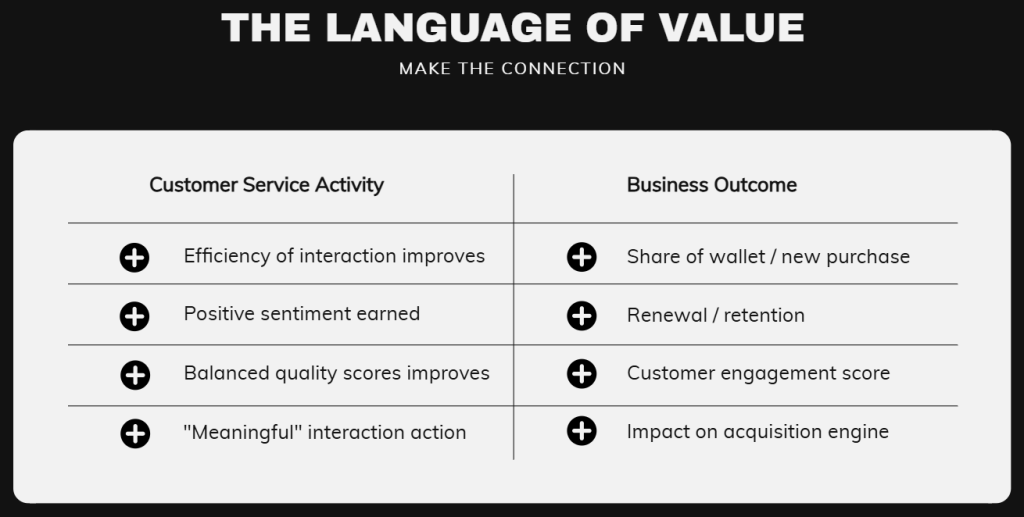
For inspiration: when working with a top five producer in the gaming industry, we discovered that by moving the needle on Customer Sentiment it had a significant impact on future player spend. This earned us freedom to strategically slow down interactions, especially with VIP’s, to ensure the best possible experience.
How can you bring balance to your interactions to maximize value? Let us be a resource as you find the right path for your organization.